Low-Resource & Cross-Lingual NLP
Building and evaluating NLP systems for under-resourced language pairs such as Japanese–Nepali, where parallel data is scarce and transfer from high-resource languages breaks down in ways worth understanding.
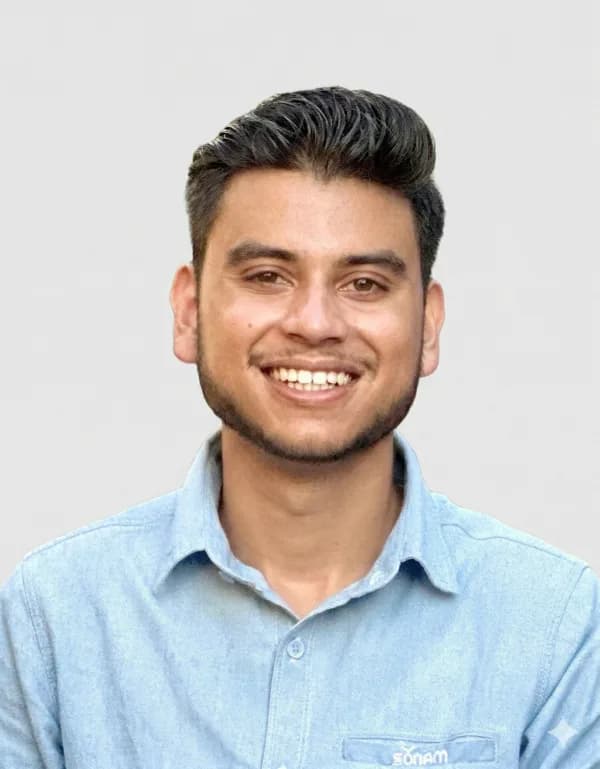
I build and evaluate NLP systems for low-resource languages and clinical text — and study whether our evaluation methods measure what we claim they do.
M.S. Student, Information and Computer Science · CCILAB, Doshisha University
Osaka, Japan · Permanent Resident of Japan
Joined CCILAB as a Research Assistant, working on cross-sensor diffusion for wearable sensor reconstruction.
Began serving as a Student Tutor at Doshisha University, mentoring incoming master's students.
Concluded my AI Engineer internship at SoranoAI after building an LLM router, an LLM-as-a-judge evaluation pipeline, and a geospatial data pipeline on Google Cloud Run.
Started NepMedJP — building the first benchmark for patient-facing Japanese–Nepali medical summarization. Manuscript targeting COLING 2027. Details
Began my M.S. in Information and Computer Science at Doshisha University, advised by Prof. Kimiaki Shirahama.
Refinetograph published in the International Journal of Information Communication Technology and Digital Convergence. Read
Research Focus
I work on natural language processing for languages and settings the field has largely passed over. My main project, NepMedJP, builds the first benchmark for patient-facing Japanese–Nepali medical summarization — a language pair with almost no parallel data and real clinical stakes for Nepali speakers living in Japan. There I design clinician-grounded evaluation rubrics and test whether automatic metrics and LLM judges measure anything a physician would actually recognize. In parallel, at CCILAB under Prof. Kimiaki Shirahama, I develop cross-sensor diffusion models that reconstruct missing wearable signals for robust human activity recognition. The thread across both is evaluation: knowing when a model's output can be trusted. I am applying to PhD programs in NLP and machine learning.
Outside research, I love playing football, watching movies and series, and following the beautiful game — a big-time Manchester City supporter.
English · Professional / research working language
Nepali · Native
Japanese · Elementary · JLPT N4 in progress
Building and evaluating NLP systems for under-resourced language pairs such as Japanese–Nepali, where parallel data is scarce and transfer from high-resource languages breaks down in ways worth understanding.
Patient-facing clinical text: generating summaries a patient can act on, grounded in what clinicians judge to be faithful, complete, and safe rather than in surface overlap with a reference.
Meta-evaluation of how we measure generation quality — whether automatic metrics and LLM-as-a-judge approximate expert human judgment, and identifying where they do not and expert assessment remains irreplaceable.
Abstractive and cross-lingual summarization across encoder–decoder and decoder-only architectures, with attention to factuality and to preserving meaning across a language boundary.
Learning shared representations across sensing modalities — including diffusion-based reconstruction of missing wearable sensor signals for robust activity recognition under incomplete sensing.
Academic Output
S. Gaire Sharma, K. Shirahama
Manuscript in preparation
Target venue: COLING 2027
S. Gaire Sharma, K. Shirahama
Manuscript in preparation
Selected Work
Flagship research first. Click a project to highlight the skills behind it — or filter via Skills below.
The first benchmark for patient-facing Japanese–Nepali medical summarization. I built NepMedJPBench — 100 parallel source–summary pairs with clinician-authored references — and a clinician-validated evaluation rubric introducing two novel cross-lingual attributes: clinical meaning preservation and medical terminology transfer. Multi-rater clinician evaluation establishes gold-standard judgments; benchmarking spans pretrained and fine-tuned mT5, Qwen3-4B (thinking and non-thinking), Qwen3.5-4B, and frontier LLMs. A meta-evaluation then tests whether automatic metrics and LLM-as-a-judge approximate clinician judgment — and where they do not.
A cross-sensor diffusion framework that reconstructs missing wearable IMU signals, enabling reliable Human Activity Recognition under incomplete sensing. Trained over 14 body-worn sensors from the OPPORTUNITY dataset across three realistic failure regimes — 35% whole-body-location, 40% single-sensor, and 25% random 2–3 sensor dropout — pairing a DDPM reconstruction model with a downstream C-LSTM-A classifier. Diffusion reconstruction significantly outperforms mean-fill imputation where missing sensors correlate strongly with observed ones. Currently extending to CogAge and PAMAP2.
Integrated web application combining SRGAN for super-resolution, Convolutional Autoencoder for denoising, and Zero-Reference Deep Curve Estimation for low-light image enhancement.
Smart rental management platform for Nepal — landlords and tenants manage buildings and units, generate Nepali-calendar invoices, track rent and electricity payments (eSewa / Khalti / bank), and handle maintenance requests in one place.
Technical Proficiency
Research and data science first — engineering and infrastructure as supporting depth. Select a skill to highlight related work.
Select a skill to see related projects above.
Career Path
Independent Research Project, Doshisha University · Kyoto, Japan
CCILAB, Doshisha University · Kyoto, Japan
LLM-jp (NII) · Japan
Doshisha University · Kyotanabe, Japan
SoranoAI (Stanford-affiliated startup) · San Francisco, CA
TeamOne Technologies · Mahalaxmi, Nepal
Academic Background
Graduate School of Science and Engineering (ISTC)
Doshisha University · Kyoto, Japan
GPA 4.10 / 4.50
Co-Creation Informatics Laboratory (CCILAB) · Advisor: Prof. Kimiaki Shirahama
Human activity recognition via diffusion-based missing modality imputation; Cross-lingual Japanese–Nepali medical text summarization
Key Coursework
Advanced College of Engineering and Management, Institute of Engineering
Tribhuvan University · Kathmandu, Nepal
First Division · 71.76% (≈ 3.6 / 4.0)
Thesis advisor: Dr. Surendra Shrestha
Refinetograph: A Machine Learning Approach Toward Image Enhancement
Key Coursework
Recognition
Nominated by the Faculty of Science and Engineering (ISTC) as one of four students, Doshisha University.
Awarded to privately financed international students, Doshisha University.
Nepal Engineering Council.
Technical Writing
Notes on AI in Japan, NLP, and systems that ship.
Three defining trends in Japan's AI market in 2026 — vertical sovereign AI, Physical × AI at the edge, and demand for bilingual AI builders who can ship enterprise systems.
Japan leads the world in industrial robotics, yet workplace AI use lags. Santosh Gaire Sharma unpacks the talent gap, aging demographics, soft regulation, and domestic LLMs reshaping Japan's AI path.
Get In Touch
Currently based in Osaka, Japan. I am open to PhD opportunities, research collaborations across Japan, and discussions about AI, NLP, data science, and healthcare. Feel free to reach out.